Okay, tell me how it is that the humor of this picture comes about. What is going on under the linguistic hood to make this funny?
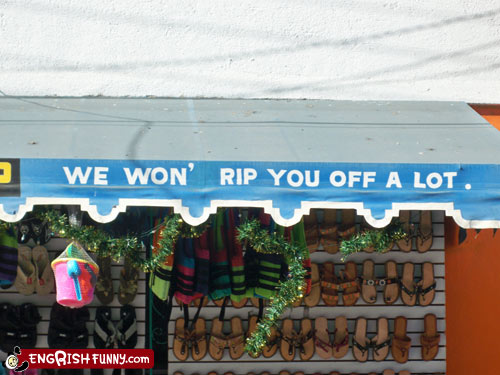
If you think you have an answer, leave a comment. And Mike, let someone else answer first.

Okay, tell me how it is that the humor of this picture comes about. What is going on under the linguistic hood to make this funny?
If you think you have an answer, leave a comment. And Mike, let someone else answer first.

Comments are closed.
All I’ll say is that the premise here is very similar to a joke that appears regularly here in my apartment…
Mike, I can’t quite see how pulling your distal phalanx is related to this sandal store but maybe I’m missing something.
I think they mean “We really won’t rip you off.”
But what is the effect of adding the caveat “very much” or “a lot”? It leaves the possibility on the table that they will rip you off. Think about me saying “Aubry is a competent blogger” versus “Aubrey is quite often a competent blogger.” Restricting a state through the use of a modifier often undermines the entire state itself.
That’s certainly true here but in my ‘translation’ I am presuming that the original language adds the emphatic at the end. This is funny in English because it changes the meaning to the opposite of what is intended. If we were to translate the English word for word with the emphatic between “we” and “won’t” we might totally change the meaning for them and they would laugh themselves silly at our expense – just like Mike allowed me to do. 😉
Perhaps they used an emphatic that wasn’t strong enough to close the door? Perhaps they were casting about for “…at all”? Thanks for the correction, I had missed that.
My thoughts exactly Dr. Runge. My friends hate it when I do this same sort of thing.
I think there’s some ellipses going on here…
“We [are] won’ [to] rip you off a lot.”
where “won'” is a shortened form of the older “wont” – meaning it is their habit to rip us off. This reading might come under fire because it essentially puts the traditional understanding on its head. Just call it the New Perspective on Rip. Or the NPR if you will.
🙂
So you are suggesting we need to rethink our presuppositions? Where is NT Wrong when you need him?
All I’m saying is that we should be aware of our presuppositions prior to jumping into exegesis. Indeed, Wrong’s presence on the web will be missed in this regard. Oh well.. as long as he keeps telling me what 50 blogs to check out each month I suppose I can forgive.
Anyway, the joke in my apartment is adding the tag, “just some” to absolute and either/or statements – especially when its a highly unusual collocation.
Mike, That doesn’t sound like nearly as much fun as I thought! I’ll shut up now just some…er I mean a lot (it rhymes better).
There are a lot of different levels of humour here.
First I’m struck by confusion over the sentence structure
– We won’t rip me off by a large amount (unlike those guys down the road who will take you for everything you’ve got).
– We will rip you off by a small amount (after all we have to make money somehow).
– We won’t rip you off at all.
If I vocalize the text it seems they may have a strong accent. That realization is amusing because it breaks the usual spelling rules and reminds me of the old “A B C D Goldfish” exercise.
Then it appears that the sign writer hasn’t corrected the spelling and so ripped off the store merchant.
Thomas: I hope that doesn’t mean I’m not as funny as I think I am!
I noticed the dropped “t” in “won’t” which to me suggests a cockney pronunciation with a glottal stop at the end of the word, which would go with the colloquialism “rip you off”. But the dropped “t” also allows this to be reanalysed as “We won! [We] rip[ped] you off a lot!”